Japanese Chef Knives: Should You Choose Gyuto Knives or Santoku Knives?
For many buyers choosing their first Japanese kitchen knife, the decision often comes down to one practical question: Gyuto or Santoku? Both are general-purpose knives. Both can handle vegetables, herbs, boneless meat, fish, fruit, and daily preparation. The better choice is not about which knife is superior in every kitchen. It depends on how the knife cuts, how much blade length the user needs, and what kind of food preparation happens most often.
As interest in Japanese chef knives continues to grow among home cooks and professionals, understanding the difference between these two shapes is useful before buying. A Gyuto is usually the more versatile main chef knife, while a Santoku is often the easier, shorter, and lighter option for everyday home cooking.
In simple terms, buyers who want one serious all-purpose knife with more reach usually lean toward a Gyuto. Buyers who want a compact knife for vegetables, smaller cutting boards, and quick family meals often prefer a Santoku.
Gyuto and Santoku: the main differences
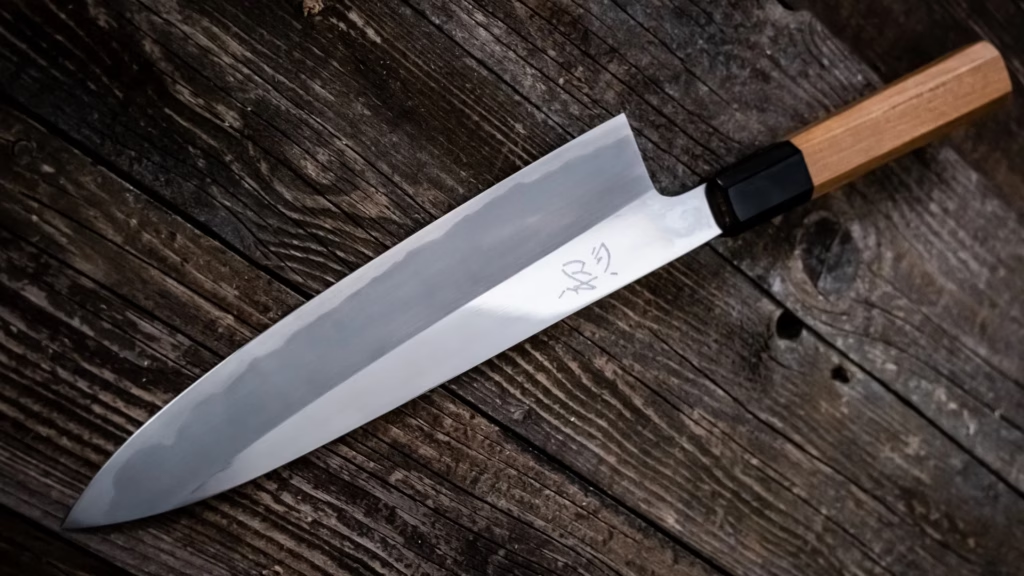
A Gyuto is the Japanese version of the Western chef’s knife. It is usually thinner, lighter, and made from harder steel than many European chef knives. Most Gyuto knives are double-bevel, which makes them suitable for most right- and left-handed users.
The name Gyuto is often translated as “cow sword,” but the modern knife is not only for meat. It is an all-purpose chef knife with a longer blade, pointed tip, curved edge profile, slimmer shape, strong slicing ability, and enough length for larger ingredients.
Common Gyuto sizes include 210 mm and 240 mm, although smaller and larger versions exist. For most users, a 210 mm Gyuto is the safest first choice. A 240 mm Gyuto makes more sense for cooks with more board space, more frequent prep work, or larger ingredients.
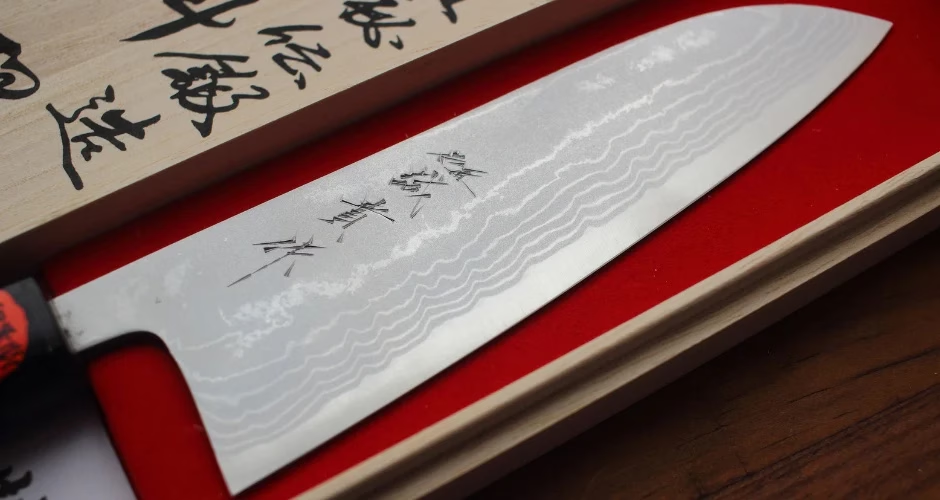
A Santoku is also an all-purpose Japanese knife, but it is shorter and more compact. Its name is commonly linked to “three virtues” or “three uses,” often interpreted as meat, fish, and vegetables, or slicing, dicing, and chopping.
A Santoku usually has a shorter blade, flatter cutting edge, taller blade body, rounded or sheepsfoot-style tip, and a controlled feel. These knives are commonly around 165–180 mm. For a practical home kitchen knife, 180 mm is often the most useful size.
The core difference is length and control. A Gyuto gives more blade length, which helps with large onions, cabbage, melons, big cuts of boneless meat, fish fillets, large bunches of herbs, and long vegetables. A Santoku gives more control in a smaller package, especially for smaller boards, limited counter space, compact cutting styles, and vegetable-heavy cooking.
This is why a Gyuto is usually the better main chef knife, while a Santoku is usually the easier everyday home knife.
Cutting style, tip shape, and kitchen use
Many buyers focus on appearance first, but cutting style matters more. Gyuto knives usually have more curve in the edge. This makes them suitable for longer slicing motions and allows some rocking, depending on the exact blade profile.
A Santoku usually has a flatter edge. This makes it strong for push cutting and up-and-down chopping, but less suitable for heavy rocking. Someone who learned on a Western chef’s knife will usually find a Gyuto more familiar. Someone who mostly chops vegetables and wants a compact blade may feel more comfortable with a Santoku immediately.
The tip also changes how the knife behaves. A Gyuto has a sharper, more pointed tip, which helps with trimming meat, scoring vegetables, cutting around cores, fine tip work, starting precise cuts, and slicing onions cleanly. A Santoku has a less aggressive tip. Its sheepsfoot-style shape can feel safer and more controlled, but it is less precise for tip-heavy work.
That does not mean a Santoku lacks precision. Its precision is compact, stable, and controlled. For cooks who use the knife tip often, a Gyuto is usually the better choice. For cooks who prefer simple and secure cutting, a Santoku often makes more sense.
Blade height is another practical factor. Santoku knives are often taller relative to their length, which gives good knuckle clearance and helps guide the knife through vegetables. A taller blade also helps move chopped ingredients from the board. Gyuto knives can also have good blade height, especially Japanese models, but they usually feel slimmer and longer.
For vegetable-heavy cooking, the Santoku has a slight advantage. It works well with onions, garlic, herbs, peppers, mushrooms, cucumbers, carrots, and smaller cabbage prep. A Gyuto is better for larger vegetables, such as large cabbage, butternut squash, big potatoes, melons, and larger root vegetables.
For boneless meat and fish, the Gyuto is usually better. The longer blade gives cleaner slicing and better reach, while the pointed tip helps with trimming and portioning. A Santoku can handle smaller meat and fish tasks, but it is not as strong for longer slices. Neither knife is made for cutting through bones. For that work, a cleaver, deba, butcher knife, or another suitable tool is required.
Which knife is better for beginners?
For most home cooks, a Santoku is easier to start with. It is shorter, lighter, less intimidating, and easier to control. It also works well on smaller boards and suits simple cutting motions.
For someone serious about cooking, a 210 mm Gyuto is the better long-term first knife. It offers more room to grow and handles more tasks, especially for larger meals or for users replacing a Western chef’s knife.
A simple buying rule is useful here. A beginner home cook will often be happier with a Santoku. A confident home cook can choose a 210 mm Gyuto. A professional or frequent cook will usually benefit from a Gyuto. A small kitchen or small board favors a Santoku. One knife for almost everything favors a Gyuto. Vegetable-heavy cooking often favors a Santoku, and sometimes a Bunka.
In practice, a knife is only versatile if it fits the kitchen. A 240 mm Gyuto may be technically capable, but it can feel awkward on a small board. A 180 mm Santoku may be less powerful for very large ingredients, but more comfortable in daily cooking.
Steel, hardness, grind, and handle matter too
The words Gyuto and Santoku describe knife shape, not overall quality. A good Santoku will outperform a poor Gyuto. A good Gyuto will outperform a decorative knife with weak geometry.
Steel is one of the most important buying factors. Common Japanese knife steels include VG-10, AUS-10, Ginsan or Silver 3, SG2 or R2, Shirogami or White steel, Aogami or Blue steel, and Aogami Super. For most buyers, stainless steel is the safest choice. First-time buyers are usually best served by VG-10, AUS-10, Ginsan, or SG2/R2 if the budget allows. Carbon steel should be chosen only by users ready to wipe, dry, and maintain the blade properly.
Hardness also matters, but buyers should not chase the highest number. Japanese knives often use harder steel than many Western knives. This can improve edge retention, but it also makes the edge more sensitive to poor use. A practical range of 60–62 HRC is a good balance for many Gyuto and Santoku buyers. Harder edges should not be used on bones, frozen food, hard shells, glass boards, stone boards, ceramic plates, or twisting cuts.
Grind and geometry matter more than visual effects. Many Japanese knives have hammered finishes, damascus patterns, black kurouchi finishes, polished bevels, or rare handles. These details can be attractive, but performance depends on how thin the knife is behind the edge, how cleanly it tapers from spine to edge, how smoothly it cuts, and how balanced it feels.
Food release is another area where buyers can be misled. Santoku knives often have wider blades, so some buyers assume they release food better. This is not always true. Food release depends on grind, blade face shape, surface finish, convexity, cutting technique, and ingredient moisture. A hammered or damascus finish does not automatically stop food from sticking.
Handle choice also affects comfort. Both Gyuto and Santoku knives can come with Japanese-style wa handles or Western-style yo handles. A wa handle is traditional and often lighter. A yo handle feels familiar to users coming from German or French chef knives. For many buyers, an octagonal wa handle is a safe Japanese-style option because it offers good control. The handle should feel secure, aligned, and smooth, without visible gaps or rough transitions.
A practical final choice
For buyers choosing between these two Japanese knife shapes, the best answer comes from honest kitchen habits. Choose a Gyuto if the goal is one serious main knife, regular cooking, larger ingredients, meat or fish slicing, more tip precision, longer slicing motions, and enough board space. The best size is usually 210 mm for most users and 240 mm for experienced cooks.
Choose a Santoku if the goal is a compact everyday knife, home cooking, smaller cutting boards, vegetable preparation, lighter handling, easy control, and comfort with a shorter blade. The best size is usually 165–180 mm.
SharpEdge Shop presents the knife as the most basic and commonly used tool in the kitchen, but also one that changes how food preparation feels. The right size, shape, steel, handle, and sharpness can turn the knife from a simple tool into an extension of the hand. Japanese chefs describe this connection as Jinba Ittai, meaning “person and horse as one body,” a sense of unity between cook and knife. With less focus on fighting the tool, there is more focus on the food.
SharpEdge Shop is positioned as a destination for high-performance blades and education around sharp kitchen knives. Its approach focuses on helping food enthusiasts and serious chefs understand why sharpness, geometry, and knife choice affect the way food is prepared. In that context, the Gyuto and Santoku are not rivals. They are two different answers to two different kitchen needs.
